why ‘omics is the future of conservation
The weird and wonderful adaptations observed across the innumerable niches of the natural world arise through a combination of stochastic processes and selective pressures acting on heritable variation. While certain traits are favored by natural selection, evolutionary outcomes are also shaped by neutral processes such as genetic drift (i.e. random chance), the strength of which depends on effective population size (Ne)—that is, the number of critters in the population that are actually contributing offspring to the next generation, rather than the full census count of individuals. In smaller populations, drift can override selection, allowing neutral or even deleterious (harmful) variants to persist, whereas in larger populations, selection more effectively retains adaptive change. Over time, the interaction of these forces contributes to population divergence and, ultimately, speciation. In this way, evolutionary biology and ecology are inherently intertwined: adaptation and interaction represent two sides of the same coin, each shaping and reinforcing the other. Their integration, i.e. eco-evolutionary theory, is particularly important in the context of environmental change, where evolutionary responses and ecological dynamics operate in continual feedback.
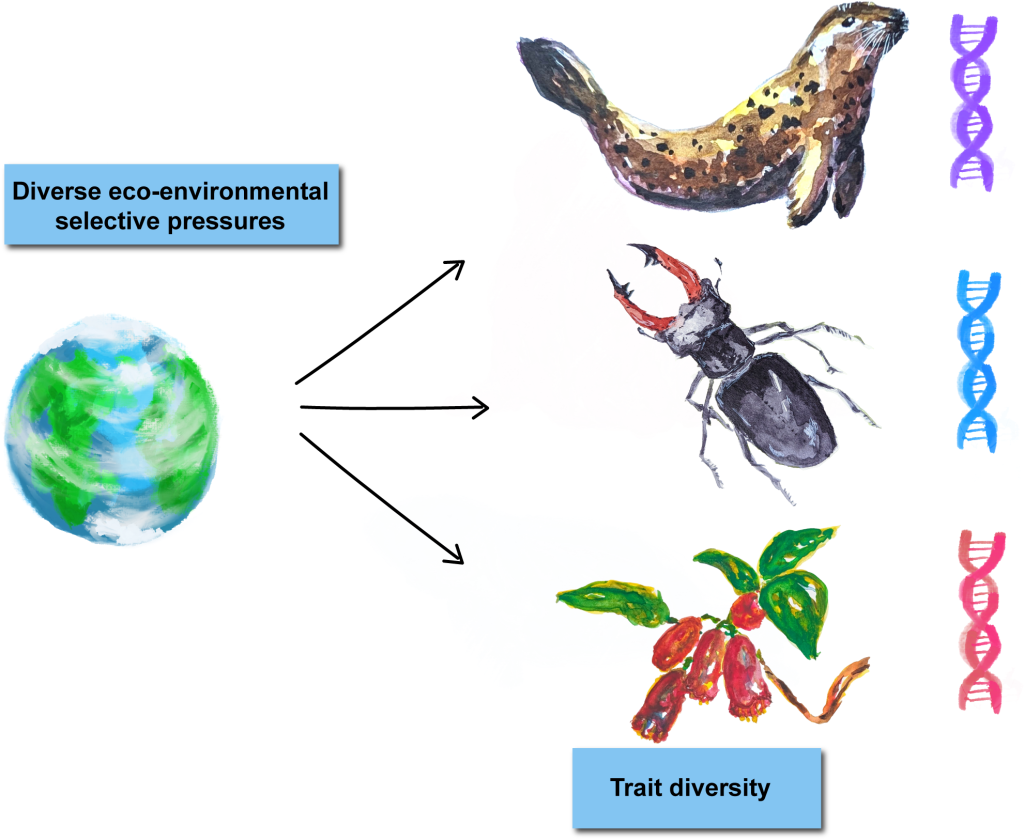
Since life first appeared, the Earth has undergone perpetual shifts in climate, geography, and atmosphere, and biological responses have followed in the form of finely tuned adaptation, dumb luck, or extinction. I want to emphasize this again: climate change is normal, and so is extinction, though the current major event is particularly extreme and it’s impossible for some species to adapt at the same rate. Nevertheless, because these processes reflect consistent relationships between selection, drift, and demographic history, patterns of past environmental change and evolutionary response can be used to inform predictions of future adaptation. As such, evolutionary ecology provides a critical framework for developing conservation strategies and identifying vulnerabilities in the current climate event.
As a computational biologist and ecologist, I am a critic of conservation (in its current state). It’s a relatively young field, popularized in the 80s, and as such, I don’t believe we’ve quite figured out how to optimize it. Conservation planning requires solid research on which to base decisions. However, these two things (policy and research) are frequently at odds because they fundamentally operate on different scales: policy is short-term and reactive, research is longer-term and proactive. So how can we research evolutionary ecology quickly? Open science can help. So can techniques like molecular ecology/evolution.
Omics technologies offer cutting-edge tools to study and understand the molecular basis and evolution of living things. Adaptation can arise through a variety of molecular mechanisms operating at different levels, like through modifications to protein-coding sequences that alter protein structure or function (which can affect the protein’s ability to do its job), changes in gene regulation that affect when, where, or how strongly genes are expressed (i.e. which genes are working hard in certain conditions or parts of the body), expansion or contraction of gene families through duplication and loss events, or changes to non-coding regulatory elements of the genes. These mechanisms are not mutually exclusive and often interact, with phenotypic adaptation usually resulting from a combination of coding and regulatory evolution. Consequently, understanding the genomic basis of adaptation requires integrating multiple lines of evidence across molecular layers. Investigating the molecular basis of phenotypic variation increasingly relies on a suite of omics technologies—including genomics, transcriptomics, proteomics, and metabolomics, to name a few—which together provide complementary insights into both sequence variation and functional biology. While genomic data reveal patterns of variation in coding and non-coding regions of genes, other ‘omics approaches are essential for understanding how traits arise through changes in gene regulation, protein function, and cellular processes. In this way, ‘omics technologies extend beyond molecular evolution in a strictly sequence-based sense, enabling the study of the physiological and cellular mechanisms that underpin adaptive traits. Think of it like watching a ballet: some of the dances are solos, some duets, some group numbers. Sometimes the dancers’ actions directly catalyze the next act of the plot, sometimes they’re used for setup or pacing. All are equally important for the experience as a whole.
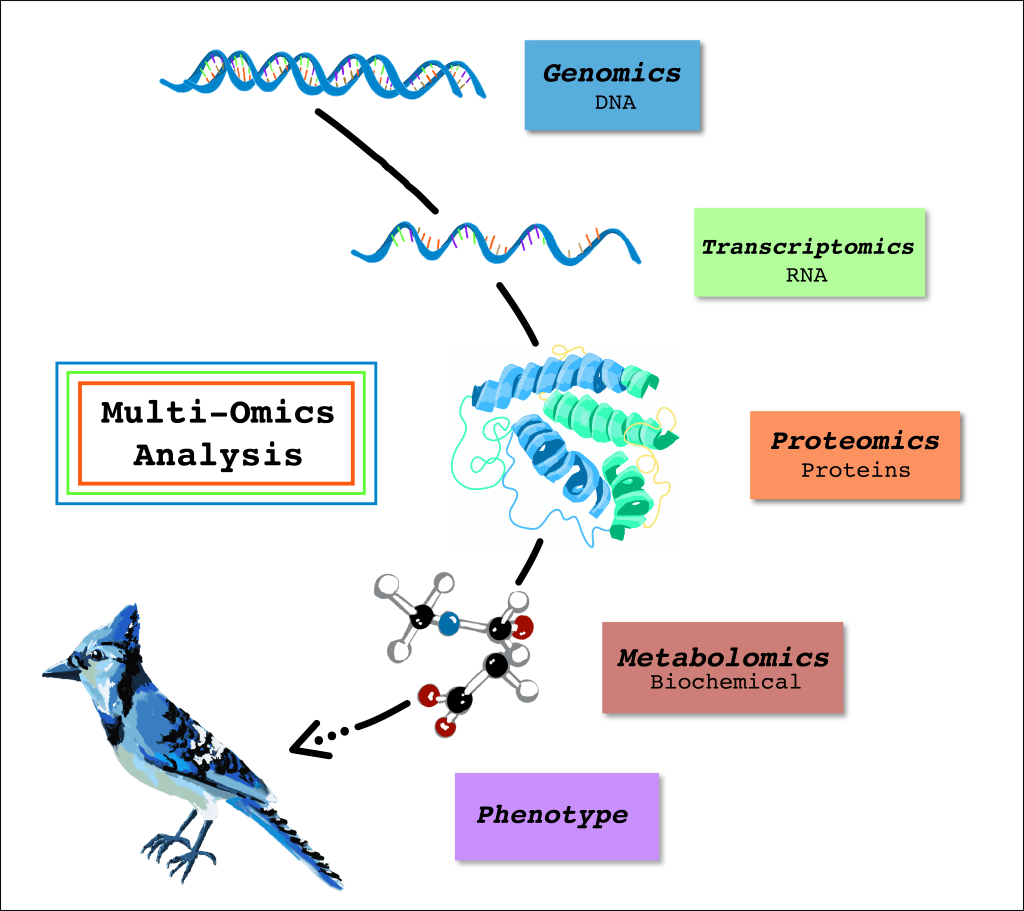
The integration of multi-omic datasets is increasingly central to modern molecular evolution. By combining sequence variation with gene expression, protein function, and metabolic profiles, researchers can move beyond identifying candidate genes to understanding the molecular architecture of adaptive traits. This integrative approach has been applied across a wide range of systems, linking genomic variation to extreme adaptations such as hypoxia tolerance in high-altitude mammals, thermoregulation in polar species, pesticide resistance in insects, and osmoregulation in extreme environments. In conservation biology specifically, ‘omics insights provide a powerful framework for understanding species resilience and vulnerability. Genomic data can identify adaptive alleles and regions under selection, while transcriptomic and functional datasets reveal how organisms respond to environmental stressors at the molecular level. These approaches underpin the emerging concept of “genomic vulnerability”, which integrates genomic variation with environmental data to predict how populations may respond to ongoing and future climate scenarios.
In parallel, advances in evolutionary genomics are enabling more direct links between genotype and phenotype, allowing trait-based predictions of adaptive capacity. For example, genomic and transcriptomic analyses of the critically endangered New Zealand kākāpō parrot have been used to identify deleterious variation and inbreeding effects associated with fertility and disease susceptibility, directly informing conservation strategies. Ringed seals offer a natural experiment in fragmentation, with land-locked subspecies such as the Saimaa ringed seals occupying small, isolated basins that formed after glacial retreat. Population genomic studies have revealed extremely low genetic diversity in the Saimaa ringed seal, consistent with severe historical bottlenecks and long-term small Ne. At the same time, population structure (inbreeding) analyses of ringed seals reveal distinct genetic clusters, suggesting that carefully managed translocations could improve genetic diversity. Imagine two long-lost siblings with complementary halves of a heart necklace set. We couldn’t have known this without a genomic study and it has massive potential for helping this species recover.
More broadly, integrating ‘omic and ecological data allows researchers to predict how key traits may respond under future environmental scenarios. As I mentioned before, conservation policy is usually reactive, addressing threats only once they become apparent. The increasingly short-term ‘omics-based methods offer a more proactive perspective by identifying early warning signs of population decline or reduced adaptive potential. As such, the speed, scale, and integrative capacity of modern ‘omics tools provide a critical opportunity to bridge the gap between scientific insight and conservation action in a rapidly changing world.
Sources: Carroll, S. B. (2008), Cell 134, https://doi.org/10.1016/j.cell.2008.06.030; Dussex, N., Van Der Valk, T., Morales, H. E., et al. (2021), Cell Genomics 1, https://doi.org/10.1016/j.xgen.2021.100002; Gould, S. J. & Lewontin, R. C. (1979), Proc. R. Soc. B 205, https://doi.org/10.1098/rspb.1979.0086; Guhlin, J., Le Lec, M. F., Wold, J., et al. (2023), Nat. Ecol. Evol. 7, https://doi.org/10.1038/s41559-023-02165-y; Hoffmann, A. H. & Flatt, T. (2022), Science 375, https://doi.org/10.1126/science.abo1817; Löytynoja, A., Rastas, P., Valtonen, M., et al. (2023), Curr. Biol. 33, https://doi.org/10.1016/j.cub.2023.01.040; Ohta, T. (1973), Nature 246, https://doi.org/10.1038/246096a0; Prud’homme, B., Gompel, N. & Carroll, S. B. (2007), Proc. Natl. Acad. Sci. USA 104, https://doi.org/10.1073/pnas.0700488104.
seals! seals! seals!
A teaser for my upcoming children’s book
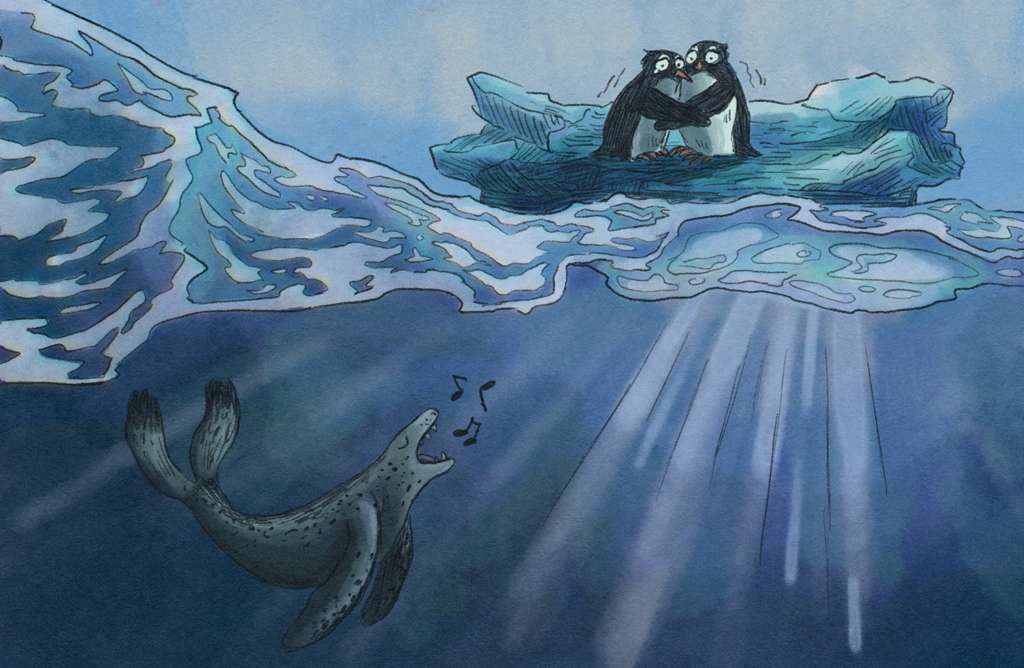
The Tale of the Singing Hunter
A spotted serenade in the South

In Antarctic black waters where icebergs drift in,
Lives a seal with a chilling, powerful grin.
The leopard seal, sleek in his mottled attire,
Is a fierce predator, one we all ought admire.

He calls out as he swims with a lonely old tune
Echoing eerily in the light of the moon.
His voice like a violin, bow to a string,
Vibrates and pulses in waves as he sings.

But although his lullaby may strike a chord,
He’s got giant jaws, so don’t be caught off guard!
With a swoop and a snap of his powerful maw,
He’s catching some penguins and eating them raw!

With a hypnotic song and a fang-filled mouth,
The leopard seal reigns over the ice in the south.

